

Cats have a reputation for being independent little creatures that appear only when they want food, attention, or a warm lap. That stereotype falls apart quickly once you meet a cat that follows its owner to the bathroom, cries outside closed doors, or insists on sleeping directly on someone’s chest every night. A clingy cat often behaves more like a shadow than a pet. Some cats constantly rub against legs, jump onto keyboards during work, or become distressed whenever their favorite person leaves the room. According to veterinary behavior experts, following humans around the house, vocalizing excessively, and demanding physical contact are among the most common signs of heightened attachment in cats.
The tricky part is figuring out whether the behavior is simply affectionate or whether it signals something deeper. Many cats naturally form strong social bonds with their humans. Research on feline attachment has shown that cats can develop attachment patterns similar to those seen in dogs and even children. That means your cat may genuinely feel emotionally secure when close to you. Still, a sudden shift from independence to nonstop attachment deserves attention because cats are masters at hiding discomfort. Think of clinginess like a smoke alarm. Sometimes it’s harmless steam from the kitchen, but other times it’s warning you that something important needs your attention.
A cat’s clinginess can also vary based on personality and breed. Breeds such as Siamese and Ragdolls are widely known for their affectionate nature and tendency to stay close to their owners. Yet even naturally social cats usually maintain some independence. When a cat suddenly becomes unusually needy, vocal, or anxious, owners should look beyond personality traits and consider environmental, emotional, or medical explanations.
Sudden Changes That Can Increase Attachment
Cats thrive on predictability. They are creatures of habit that rely heavily on familiar routines, stable environments, and recognizable scents. Even subtle changes can throw off their emotional balance. Something as simple as rearranging furniture, changing work schedules, or spending more time away from home can trigger clingy behavior. Imagine waking up one day and discovering your entire daily rhythm has changed without explanation. That confusion is similar to what many cats experience when their environment suddenly shifts.
One of the most common triggers for clinginess is a major household transition. Moving to a new home, welcoming a baby, introducing another pet, or having guests stay over can create insecurity. Cats may respond by attaching themselves more intensely to the person they trust most. Veterinary behavior articles frequently point to environmental disruptions as a leading cause of increased attachment. A once-independent cat may suddenly trail behind its owner from room to room because that person becomes the only “safe zone” in a changing world.
Even positive changes can cause stress. A new relationship, a remote work schedule, or extended vacations at home can unintentionally reshape your cat’s expectations. During periods when owners spend excessive time with their pets, cats often grow accustomed to constant companionship. When routines shift back to normal, clinginess may intensify. Reddit discussions among cat owners reveal a surprisingly common pattern: cats becoming dramatically more attached after periods of prolonged human presence, such as holidays, illness recovery, or work-from-home routines.
Cats also react strongly to emotional energy inside the home. Tension, arguments, loud noises, or emotional stress among family members can affect feline behavior. Some cats respond by hiding, while others become overly affectionate. It’s almost as if they are trying to anchor themselves emotionally by staying physically close to their humans.
Seeking Comfort During Stressful Situations
Stress affects cats more deeply than many owners realize. Unlike humans, cats cannot verbalize fear or uncertainty. Instead, they communicate through behavior. Clinginess can become a coping mechanism during stressful periods because proximity to a trusted person provides reassurance. Think about a child holding tightly onto a parent’s hand in a crowded place. Cats often do the feline equivalent by staying close, purring constantly, or seeking nonstop physical contact.
Environmental stressors are among the biggest contributors to sudden attachment. Construction noise, thunderstorms, fireworks, unfamiliar visitors, or changes in household scent can make cats anxious. Some cats react to stress by hiding under beds, while others become “Velcro cats” that refuse to leave their owner’s side. Veterinary experts have observed that anxious cats frequently seek more interaction and physical reassurance during periods of uncertainty.
Cats are also remarkably sensitive to human emotions. Many owners notice increased clinginess during emotionally intense moments such as grief, illness, or pregnancy. Experts believe cats can detect changes in scent, body language, routines, and emotional tone. While science has not fully confirmed every claim about feline emotional awareness, it is clear that cats respond strongly to changes in human behavior. If you are stressed, anxious, or emotionally overwhelmed, your cat may react by becoming more attached and attentive.
Stress-related clinginess often comes with additional signals. These may include excessive meowing, changes in appetite, pacing, overgrooming, or sleeping patterns that suddenly shift. A cat that used to nap peacefully alone may suddenly insist on sleeping only beside its owner. That behavior is not random. It reflects a search for emotional security in an environment that feels uncertain or unpredictable.
Attention-Seeking Behaviors and Reinforcement
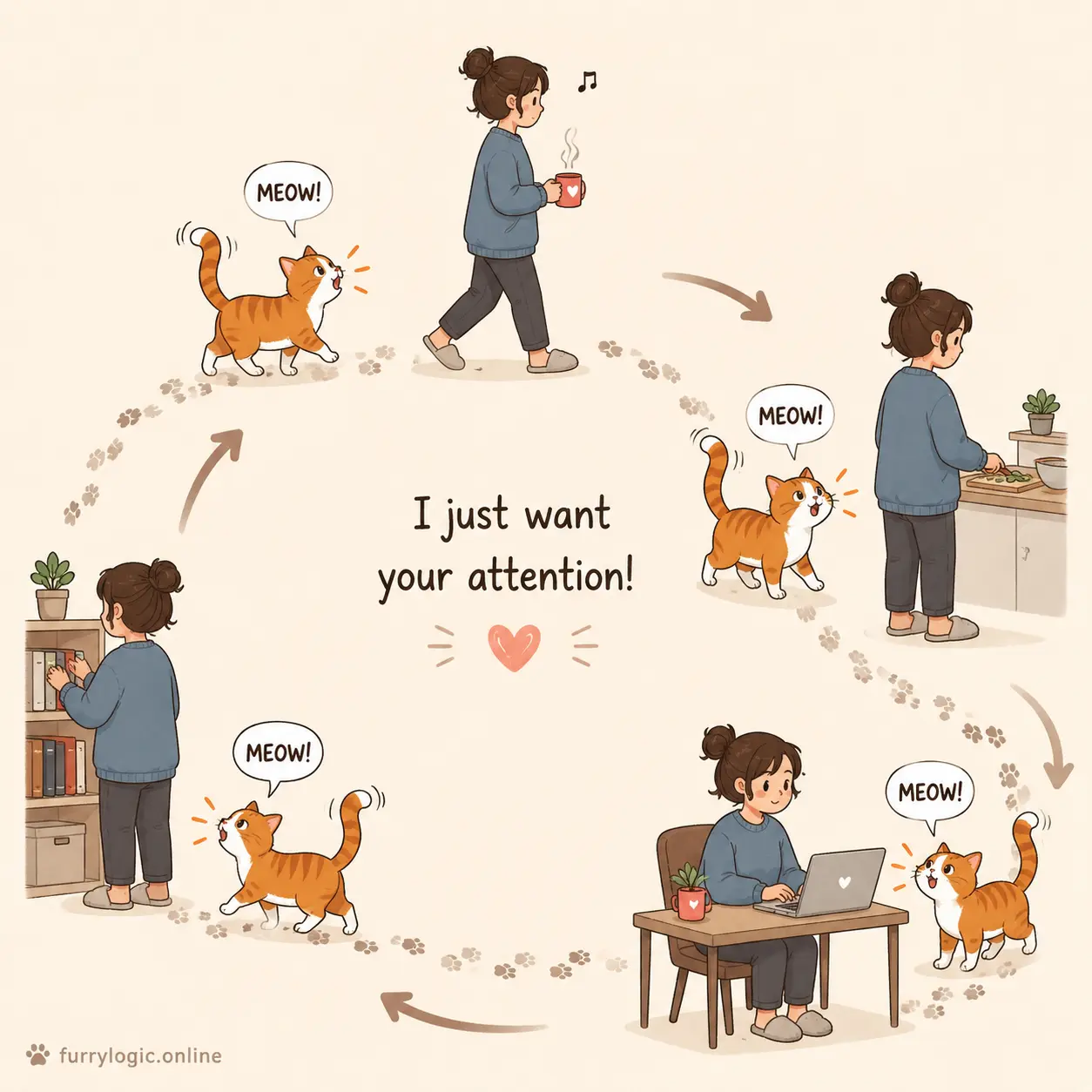
Sometimes cats become clingy simply because the behavior works exceptionally well. Cats are intelligent observers. If following you around leads to treats, petting, or verbal interaction, they quickly learn that attachment produces rewards. Over time, accidental reinforcement can turn ordinary affection into persistent attention-seeking behavior.
Picture this scenario: your cat meows loudly whenever you enter another room. Each time it happens, you respond by petting the cat or talking soothingly. From the cat’s perspective, the strategy is a complete success. The behavior becomes reinforced and gradually intensifies. Many owners unintentionally train clinginess without realizing it. Discussions among cat owners frequently mention habits like constant cuddling, immediate responses to vocalization, or excessive reassurance as contributors to overly dependent behavior.
Boredom also plays a major role. Indoor cats especially rely on their owners for stimulation and entertainment. Without enough enrichment, a cat may treat its human like the only exciting object in the environment. This often leads to behaviors such as constant following, pawing at laptops, interrupting sleep, or demanding interaction at inconvenient times. Veterinary behavior resources consistently point to boredom and under-stimulation as major contributors to clinginess.
Here is a quick breakdown of common reinforcement patterns:
| Behavior | Human Response | Result |
|---|---|---|
| Loud meowing | Immediate attention | More vocalization |
| Following constantly | Picking up or petting | Increased attachment |
| Pawing at owner | Treats or playtime | Learned dependency |
| Crying outside doors | Door opened instantly | Separation anxiety reinforced |
The goal is not to ignore your cat emotionally. Cats still need affection and bonding time. The key is balance. Encouraging independent play, puzzle feeders, climbing spaces, and scheduled interaction helps prevent emotional overdependence while still maintaining a strong relationship.
Could Age or Health Be Playing a Role?
One of the most important things to remember is that sudden clinginess can sometimes signal a medical issue. Cats rarely communicate illness in obvious ways. Instead of crying out in pain, they often display subtle behavioral shifts. Increased attachment may be their way of seeking comfort, protection, or assistance during physical discomfort.
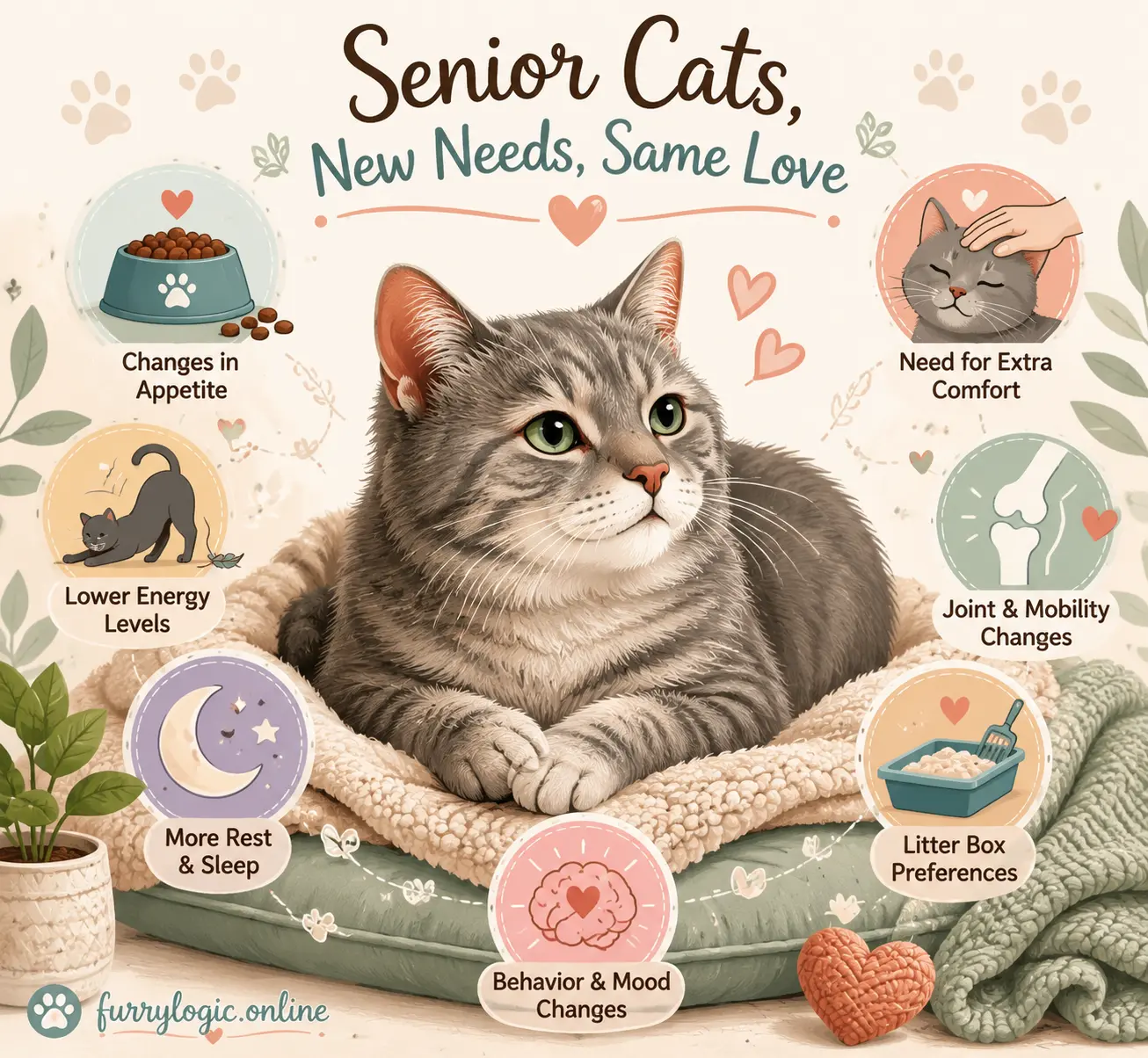
Senior cats are particularly prone to behavioral changes. Aging can bring confusion, anxiety, sensory decline, and cognitive dysfunction. Older cats may become more vocal at night, follow owners constantly, or appear unusually needy because they feel vulnerable. Veterinary experts note that hypertension, cognitive decline, and age-related anxiety frequently contribute to clingy behavior in older cats.
Several medical conditions are strongly associated with sudden clinginess. Hyperthyroidism can increase activity levels and restlessness, causing cats to seek more interaction. Diabetes may create constant hunger and vocalization. Pain from arthritis, dental disease, or gastrointestinal disorders can also drive cats toward increased attachment because owners represent safety and comfort. A 2025 veterinary study found that cats with inflammatory gastrointestinal or skin disorders displayed higher levels of anxious and care-seeking behavior compared to healthy cats.
The following table highlights possible medical links:
| Medical Issue | Possible Behavioral Signs |
|---|---|
| Hyperthyroidism | Hyperactivity, vocalization, clinginess |
| Diabetes | Increased hunger, attention-seeking |
| Arthritis | Following owners for comfort |
| Cognitive dysfunction | Confusion, nighttime anxiety |
| Gastrointestinal disorders | Increased reassurance-seeking |
Pain changes behavior dramatically. A cat that suddenly becomes clingy after being independent for years should always be evaluated carefully. Veterinary professionals repeatedly emphasize that sudden behavioral changes should never be dismissed as “just personality.”
Reading the Signals Behind Constant Following
A cat that follows you everywhere is communicating something important. The challenge is decoding the message correctly. Following behavior can indicate affection, curiosity, boredom, anxiety, illness, or emotional dependency. Context matters enormously. A relaxed cat that casually trails behind you while purring likely feels socially bonded. A tense cat that cries when separated may be struggling with stress or insecurity.
Body language provides valuable clues. Cats seeking comfort often display soft blinking, gentle purring, tail wrapping, and close body contact. Anxious clinginess, however, may come with flattened ears, excessive vocalization, pacing, or frantic attention-seeking. Veterinary experts encourage owners to observe accompanying behaviors rather than focusing on attachment alone.
Separation anxiety is another growing concern among indoor cats. While people usually associate separation anxiety with dogs, cats can experience it too. Some cats become distressed whenever owners leave the house or even close a door. They may yowl loudly, scratch at doors, refuse food, or become destructive. Online cat communities frequently discuss cases where cats panic when unable to locate their owners, especially after routine disruptions or traumatic experiences.
A useful way to interpret clinginess is to ask yourself three questions:
- Did the behavior appear suddenly or gradually?
- Are there additional physical or emotional symptoms?
- Has anything changed in the environment recently?
Those questions often reveal whether the behavior stems from affection, stress, boredom, or a potential health issue. Cats communicate through patterns rather than words, so owners must become careful observers of changes in behavior, mood, and routine.
Ways to Support a More Balanced Routine
Helping a clingy cat does not mean pushing them away emotionally. The goal is to create confidence, security, and healthy independence. Think of it like parenting a child who needs reassurance. Constant dependence may feel comforting temporarily, but long-term emotional balance comes from building confidence and stability.
Environmental enrichment is one of the most effective solutions. Cats need mental stimulation, physical activity, and opportunities to engage natural instincts. Interactive toys, climbing shelves, scratching posts, window perches, and puzzle feeders all help redirect focus away from constant human attention. Veterinary behavior experts regularly recommend enrichment strategies to reduce clingy tendencies.
Predictable routines also make a huge difference. Cats feel safest when daily life follows a reliable rhythm. Feeding schedules, play sessions, bedtime habits, and quiet periods should remain as consistent as possible. Random interaction patterns can accidentally increase anxiety because the cat never knows when attention will appear or disappear.
Here are practical strategies that often help:
- Schedule dedicated play sessions twice daily
- Rotate toys regularly to prevent boredom
- Reward calm, independent behavior
- Avoid reinforcing excessive vocalization
- Create quiet resting areas away from constant activity
- Use puzzle feeders to encourage solo engagement
- Introduce changes gradually whenever possible
Some owners benefit from calming pheromone diffusers or anxiety-reduction strategies recommended by veterinarians. These tools can help cats feel more secure during stressful transitions. Most importantly, patience matters. Cats do not change emotional habits overnight. Consistency and gentle structure gradually help them regain confidence and independence.
Red Flags That Should Not Be Ignored
Not all clinginess is harmless. Sometimes it represents the earliest warning sign that something is physically or emotionally wrong. Cats instinctively hide weakness, so even subtle changes deserve attention. A cat that suddenly transforms from independent to intensely needy without an obvious explanation should always be monitored closely.
The biggest red flags include clinginess paired with physical symptoms. Weight loss, vomiting, appetite changes, excessive thirst, litter box issues, or unusual vocalization may indicate illness. Hyperthyroidism, diabetes, pain disorders, and neurological conditions can all trigger behavioral changes. If clinginess appears alongside these symptoms, a veterinary visit becomes essential rather than optional.
Behavioral intensity also matters. A cat that panics when separated, cries nonstop, stops eating, or becomes destructive may be experiencing severe anxiety. Excessive dependence can escalate into chronic stress, which negatively affects feline health and wellbeing. Cats suffering from emotional distress often display additional signs like overgrooming, aggression, pacing, or disrupted sleep patterns.
Watch for these warning signs carefully:
| Red Flag | Why It Matters |
|---|---|
| Sudden clinginess | Possible illness or stress |
| Excessive vocalization | Anxiety or medical discomfort |
| Appetite changes | Potential metabolic disease |
| Aggression with clinginess | Fear or pain response |
| Litter box problems | Stress or health issue |
| Nighttime confusion | Cognitive dysfunction |
Veterinary professionals consistently stress the importance of early intervention. Cats often recover more successfully when behavioral or medical concerns are identified quickly rather than ignored for months.
Conclusion
A clingy cat is not necessarily a bad thing. In many cases, it reflects trust, affection, and a deep emotional bond between pet and owner. Cats are far more socially connected than old stereotypes suggest. They seek comfort, reassurance, and companionship in ways that can sometimes surprise even experienced cat owners.
The important detail is understanding the difference between normal affection and behavior that signals stress, anxiety, or illness. Sudden attachment changes often point toward environmental disruptions, boredom, emotional insecurity, aging, or medical problems. Paying attention to timing, body language, and accompanying symptoms helps uncover the real reason behind the behavior.
Cats communicate through actions instead of words. Constant following, vocalizing, and physical closeness are all forms of communication. When owners respond thoughtfully rather than reactively, they can strengthen the bond while still encouraging emotional balance and independence. A healthy cat-human relationship is not about constant dependence. It is about security, trust, and understanding what your cat is trying to tell you.
FAQs
Why is my cat suddenly following me everywhere?
Sudden following behavior is often linked to stress, environmental changes, boredom, or medical issues. Cats may also become more attached during routine disruptions or emotional changes inside the home.
Can clinginess in cats mean they are sick?
Yes. Veterinary experts warn that sudden clinginess may signal conditions such as hyperthyroidism, diabetes, pain disorders, or cognitive dysfunction.
Is separation anxiety common in cats?
It is more common than many people realize. Some cats become distressed when owners leave, especially after major routine changes or long periods of constant companionship.
How can I help my clingy cat become more independent?
Interactive toys, puzzle feeders, climbing spaces, scheduled play sessions, and predictable routines all help encourage confidence and reduce excessive dependence.
Should I take my cat to the vet for clingy behavior?
If the clinginess is sudden, intense, or paired with symptoms like appetite changes, excessive vocalization, aggression, or litter box problems, a veterinary evaluation is strongly recommended.

Dorian Keene is an American content writer and blogger based in Boise, Idaho. At 31 years old, he has spent several years researching and writing practical, well-sourced articles focused on consumer guides, digital trends, and lifestyle topics. His experience working with online publications has helped him develop a clear, trustworthy writing style that prioritizes accuracy and reader value. As a contributor to furrylogic.online, he is committed to creating informative content that reflects careful research, real-world insights, and dependable editorial standards.